
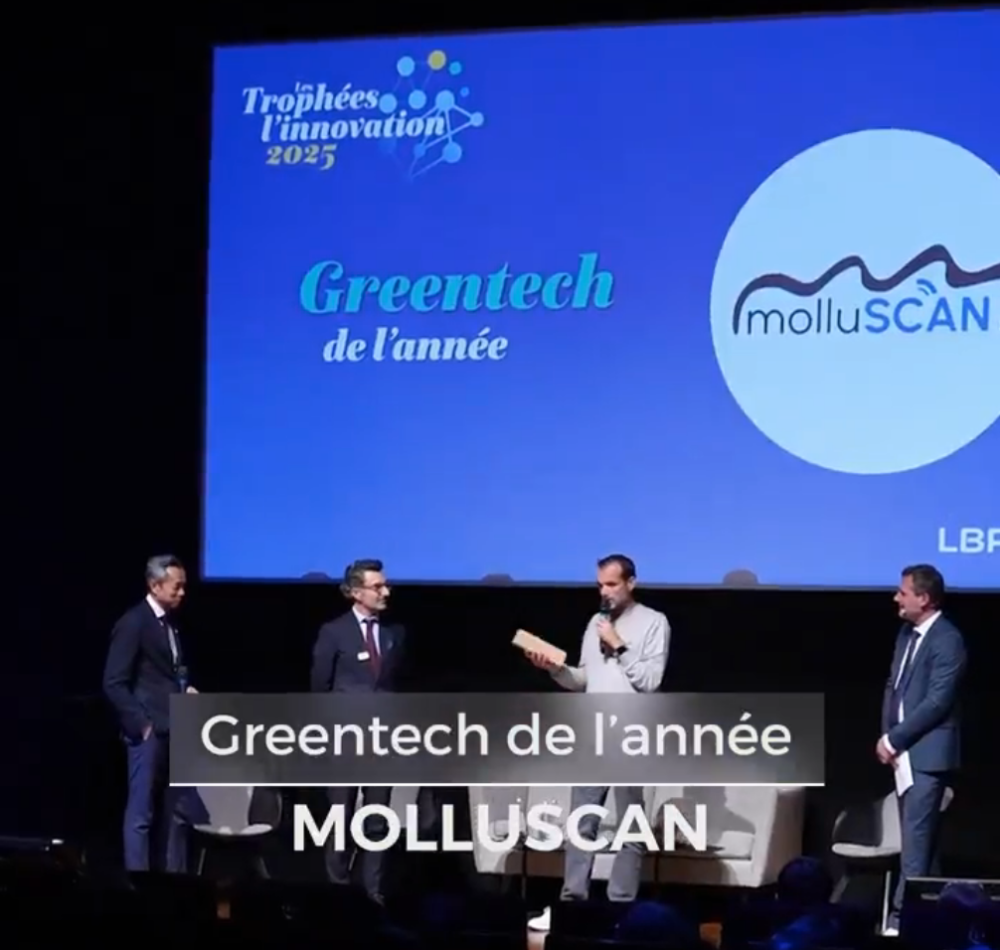
Receiving the LBP AM Innovation Award in the GreenTech category is a source of pride for the entire molluSCAN-eye team. But beyond recognition, this award validates an urgent paradigm shift that I had the opportunity to explain on the Smart Bourse television programme: we can no longer monitor tomorrow’s water with yesterday’s methods.
This is why the industry is gradually shifting from spot chemical testing to continuous biomonitoring.
The problem with the “class photo”
As I explained to journalist Grégoire Favet, the traditional method of monitoring water quality relies mainly on physical and chemical sampling. It is a precise, standardised method, but it has one major flaw: it is intermittent. Taking a chemical sample is like taking a class photo once a month. You know exactly who is there at that moment. But if pollution occurs the next day, or the following night, it goes “under the radar”. In a context where 40% of the wastewater monitoring market is shifting towards continuous monitoring, this temporary “blindness” becomes an unacceptable industrial and environmental risk.
The solution: real-time film (valvometry)
This is where molluSCAN-eye comes in. We don’t replace chemistry, we make it intelligent. Our technology uses bivalve molluscs (oysters, mussels) as connected sentinels. These animals filter up to 50 litres of water per day. When they detect a disturbance, they react immediately by changing their opening/closing behaviour. Thanks to our High Frequency Non-Invasive Valvometry (HFNI) sensors, we capture these micro-movements 24/7.
Conventional chemistry = A blurry photo every month.
MolluSCAN-eye = Live high-definition footage of what’s happening underwater.
Why are industrial companies like SUEZ adopting this solution?
Biomonitoring is no longer a laboratory tool, it is an operational decision-making aid. During the interview, I mentioned our partnership with SUEZ, which uses our systems to monitor discharges from wastewater treatment plants. For an industrialist or port manager, there are three benefits:
Proactive compliance: Anticipate threshold exceedances before they become regulatory violations (Water Framework Directive).
Targeted savings: Instead of carrying out multiple costly chemical tests blindly, analysis is only triggered when molluscs give the alert (“biologically triggered”).
Image protection: Prove through a trusted biological third party that industrial activity does not impact the receiving environment.
Low-tech but high-data technology
This GreenTech award also recognises the simplicity of our approach. We do not add complex probes that require heavy maintenance. We use living organisms, which have had millions of years of R&D to perfect their sensitivity to water. We simply connect nature to the Cloud. It is this alliance between marine biology and the IoT that now makes it possible to secure port areas, drinking water intakes and aquaculture farms alike.
Want to know more about our deployments?
Find out how we secure ports and industrial areas on our [Our Achievements] page.